Choosing the Sheet and Essence for Your Sheet Mask: A Spec Checklist for Brand Owners
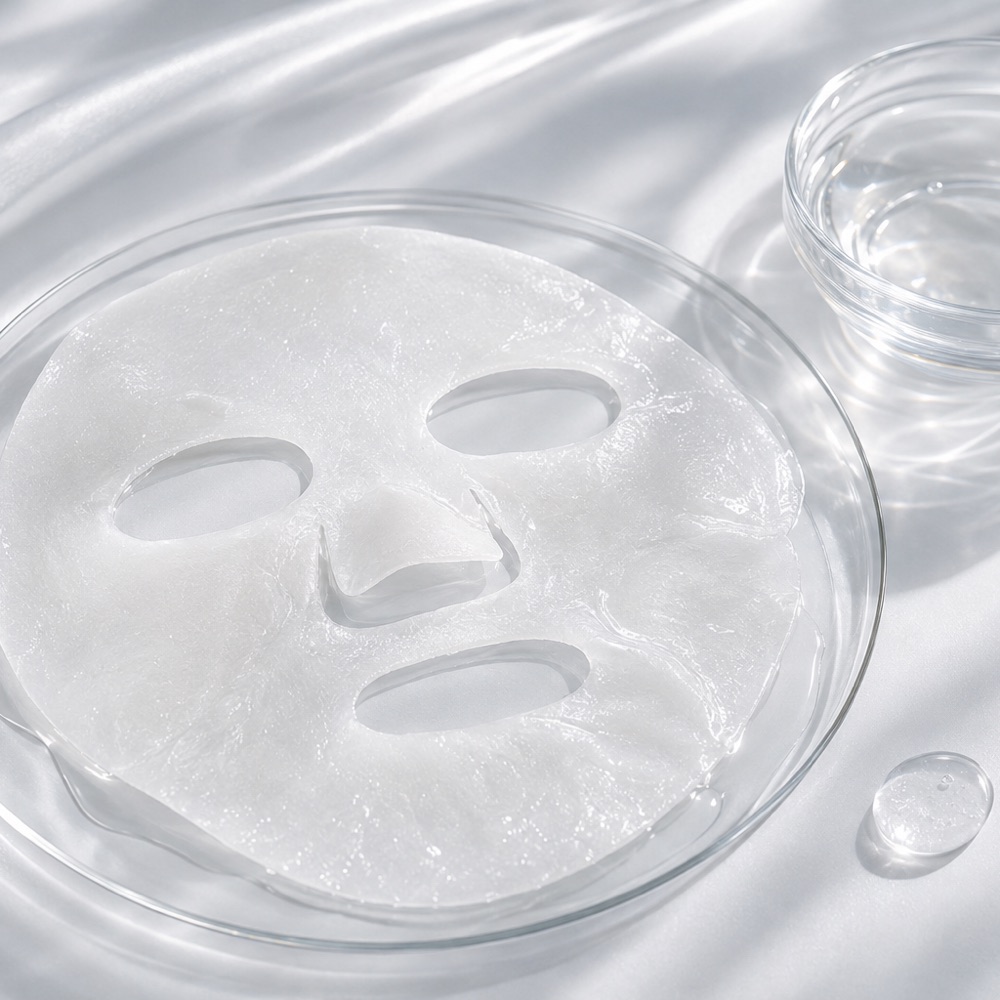
You can't choose a sheet mask by the sheet alone, or by the essence alone. The sheet determines how well the mask fits and how it feels. The essence's thickness and volume determine whether the mask feels wet enough, whether it drips, and whether skin feels sticky afterwards. The pouch and outer box shape the consumer's first impression when they open it. Sample all three as a set, confirm them together, and then write them into a spec sheet.
Key takeaways
To see which sheet materials and mask formats Misatsu can produce, see our full mask manufacturing range. This article covers what brand owners need to compare, test and decide when developing a sheet mask.
Sheet materials compared: feel, fit and development notes
The table below shows the general characteristics of common sheet mask materials. The actual feel varies with the supplier, the basis weight and the processing, so always judge from the actual sheet during sampling.
| Material | Feel and appearance | Fit | Thickness | Development notes |
|---|---|---|---|---|
| Non-woven | Whitish and opaque, feels relatively dry | Average; tends to lift along facial contours | Many specs available, thin or thick | Too thin tears easily, too thick won't cling to the face; test with the actual essence volume |
| Tencel (lyocell) | Soft and skin-friendly, semi-transparent when wet | Good | Thin | Compare stretch and transparency when wet using actual samples |
| Cupro | Very fine and thin, nearly transparent when wet | Very good, like a second skin | Very thin | Because it is thin it wrinkles easily; check the folding and how easily it unfolds |
| Bio-cellulose | Gel-like when wet, feels cool | Very good | Relatively thick | The sheet itself holds water and usually comes with a backing liner; design the steps for unfolding and applying it |
| Hydrogel | Jelly-like and elastic | Good, rarely drips | Thick | The essence is usually built into the gel, so the formula and molding are developed together; this is a different development route from "sheet plus essence" |
Our service page also lists silk and graphene sheets. These materials have more specific characteristics and claim considerations. For example, how a graphene sheet can be described should be checked against the regulations before it goes into your copy.
Decide the cut at the same time
Beyond the material, the cut of the sheet affects fit and the user experience:
- One-piece or two-piece (upper and lower): a two-piece mask is easier to align with the chin and forehead, but adds a step when opening.
- Size and position of the eye, nose and mouth openings: if they are too large, the under-eye area and mouth corners may not be covered; too small, and they get in the way of breathing and vision.
- Ear-loop or standard: ear loops let users move around while wearing the mask, which suits brands built around "low-effort skincare".
- Size: the face size of your target customers affects whether the chin and forehead are fully covered.
Matching the essence to the sheet
The same essence can feel completely different in different sheets. When matching them, look at four things:
- Different sheets absorb different amounts. Thin sheets hold less; thick sheets need more essence to be fully soaked. If you change the sheet, re-test the volume.
- Too little or too much essence both cause problems. Too little, and the edges dry out and lift halfway through; too much, and it drips onto clothes when the pouch is opened and a lot is left in the pouch. Some customers love having "enough left over for the neck and hands", while others find it wasteful and messy. This is a positioning question, so decide it first.
- The thickness of the essence. A thicker essence feels like it stays on the skin, but may string during filling and opening; a thinner one spreads easily but drips more.
- How skin feels afterwards. Whether users should massage it in after removing the mask, whether it feels sticky, and whether it should be rinsed off all need to be stated clearly in the directions, and they affect whether consumers buy again.
How to test the essence volume: using the actual sheet and the actual pouch, make two or three volume versions and have the same group of people try them. Record whether it drips when the pouch is opened, whether the edges have dried out after the recommended wearing time, how much is left on the face after removal, and how much is left in the pouch. This is far more useful than discussing it on paper.
How the mask conveys your brand positioning
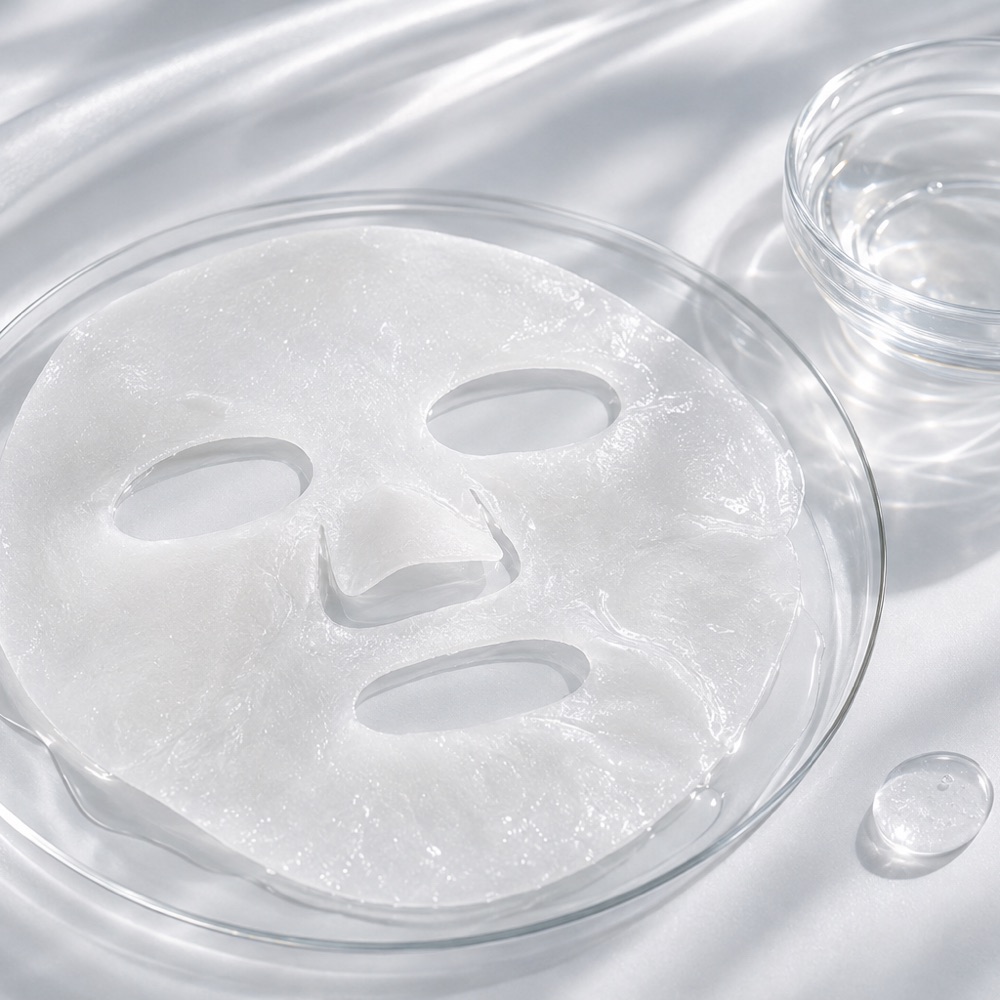
A sheet mask is one of the few skincare products that makes consumers stop for ten-plus minutes. The moment the sheet touches the face, the sound and amount of essence when the pouch is opened, and the color and transparency of the mask in photos all become memorable moments. When choosing a material, use the table below to compare it with the impression your brand wants to give.
| Material | Brand image it suits | What users remember | Unboxing and social media appeal | Suitable channels |
|---|---|---|---|---|
| Non-woven | Everyday, friendly, practical | Familiar and easy to use | Lower; stands out through packaging design and bundles | Drugstore and mass retail shelves, multi-pack family sizes |
| Tencel | Gentle, natural, lifestyle | Soft against the skin | Medium; suits content that highlights feel | E-commerce, drugstores, lifestyle select shops |
| Cupro | Refined, light, urban | "Almost invisible once applied" | High; the transparency photographs well | E-commerce, department store counters, gift sets |
| Bio-cellulose | Premium, professional care | Cool, substantial, enveloping | High; peeling off the liner feels like a ritual | Salons, beauty studios, premium retail |
| Hydrogel | Novel, buzzworthy, targeted care | Jelly-like bounce and coolness | High; targeted formats such as eye patches make fun content | E-commerce, gift sets, seasonal bundles |
The material is only the starting point. Even a non-woven mask can create a distinctive brand impression when paired with a well-designed single pouch and a clear usage scenario (for example "the night before a business trip" or "after a long-haul flight"). The key is that the material, the essence volume, the pouch and the copy all say the same thing. If your brand positioning isn't settled yet, start with skincare brand positioning; for preparing launch content, see launch marketing preparation.
Pouches and outer boxes
Single aluminum foil pouches. Laminated aluminum foil pouches block light, air and moisture, and are the most common choice for sheet masks. You need to decide the pouch size, the tear-notch position, matte or gloss finish, the number of print colors and the design. If single pouches will circulate on their own, for example sold individually, given as samples or packed into bundles, each pouch must carry the required labeling by itself. Before designing, confirm that the layout has room for all the required text.
Multi-mask boxes. Boxes of 3, 5, 7 or 10 masks are common. You need to decide the box material, how the masks are held in place, and how they are arranged when the box is opened. Boxed sets lend themselves to social media content, such as a seven-mask weekly box with seven different pouch colors.
Other formats. Clay masks and gel masks come in jars, and rinse-off masks can come in tubes; these are different development routes from sheet masks. Gift boxes suit seasonal promotions and gifting. For general packaging considerations, see the packaging selection guide. If you are still deciding whether your first product should be a mask or a serum, see the serum development guide.
Design and printing. Misatsu works with a partner design team that can provide two to three initial design concepts. If you have your own designer, that works too: Misatsu provides the dieline, and once the design is finished we carry out a regulatory review and a pre-press check. Outer boxes can be finished with gold foil, silver foil, spot UV, embossing, matte finishes and more.
Testing and confirmation checklist
The items below fall into two groups: tests the manufacturer runs as part of its standard process, and things brand owners should check for themselves.
Tests in the manufacturer's process
- Stability testing: whether the essence separates, changes color or changes odor under high temperature, low temperature, centrifuge and other conditions.
- Packaging compatibility: whether anything abnormal happens after the essence is in contact with the pouch's inner layer and the sheet.
- Preservative efficacy testing: confirming that the formula's preservative system is adequate.
- Microbiological testing of the finished product: products are released for shipment only after passing, with a test report and retained samples.
What brand owners should check themselves
- Actual wear test: fit, whether it drips when the pouch is opened, whether it dries out after the recommended wearing time, and how skin feels after removal.
- Opening and unfolding: whether the folded sheet opens out easily and whether the liner peels off easily.
- Pouch feel and tear notch: whether an average person can tear it open easily with one hand.
- Shipping conditions: whether multi-mask boxes still look intact and stay sealed after being squeezed in transit.
- Label copy: whether the product name, directions, precautions, full ingredient list, responsible company details and so on are complete, and whether the claim wording stays within regulatory limits. For labeling requirements, see our regulatory section.
- Position of the batch number and expiry date: these are inkjet-printed during filling, so leave a blank area for them in the design.
Spec checklist before placing an order
Every item below needs a clear answer and should be written into the product specification. If any item changes later, check whether testing needs to be redone. For what to send when you first contact a manufacturer, see what to prepare before contacting a skincare manufacturer.
| Category | Specs to confirm |
|---|---|
| Product | Product name, product type (sheet mask, eye mask, targeted mask, etc.), main concept and claim wording |
| Sheet | Material, cut (one-piece or two-piece, openings, ear loops), size, folding, whether there is a liner |
| Essence | Approved sample number, volume per mask, fragrance, color, whether it needs to be rinsed off after use |
| Single pouch | Pouch structure, size, tear-notch position, matte or gloss, number of print colors, labeling on each pouch |
| Outer box | Masks per box, box material, how masks are held in place, finishing, labeling on the box |
| Instructions | Directions and recommended wearing time, precautions, whether an instruction leaflet is included |
| Labeling | Inkjet position for batch number and expiry date, full ingredient list, responsible company details |
| Documents | Division of work for product registration and the Product Information File (PIF); see the PIF guide |
| Timeline | Target launch date, whether it ties in with a seasonal promotion |
Sheet mask development includes sampling, stability testing, building the PIF, packaging design and print proofing, and mass production. From the first requirements discussion to the first shipment, a complete new product typically takes about 4 to 6 months. The actual time depends on the formula, stability test results, packaging and the number of sample revisions, and the choice of sheet material and printed packaging also affects progress. To plan backwards from your launch date, see the timeline from sample to mass production.
FAQ
Q: Can the same essence be used with two different sheets?
Yes, but the two sheets absorb different amounts, so the volume needs to be tested for each, and compatibility needs to be confirmed for each as well. We recommend planning them as two separate SKUs.
Q: Does changing the sheet supplier make a difference?
Yes. Even if both are called Tencel or non-woven, different suppliers' sheets can differ in thickness, absorption and feel. If you want to change the sheet after mass production has been confirmed, re-test the mask on the face and re-confirm compatibility.
Start developing
Planning your own skincare line?
You don't need every detail. Share what you know, mark the rest "undecided", and we will help you plan the next step.
- Brand concept and target customers
- Product type (serum, mask, cream...)
- Target launch date and sales channels
Related manufacturing services
Planning your own brand? These OEM/ODM services relate to this article. Everything is made in our TFDA GMP-certified factory in Taiwan.